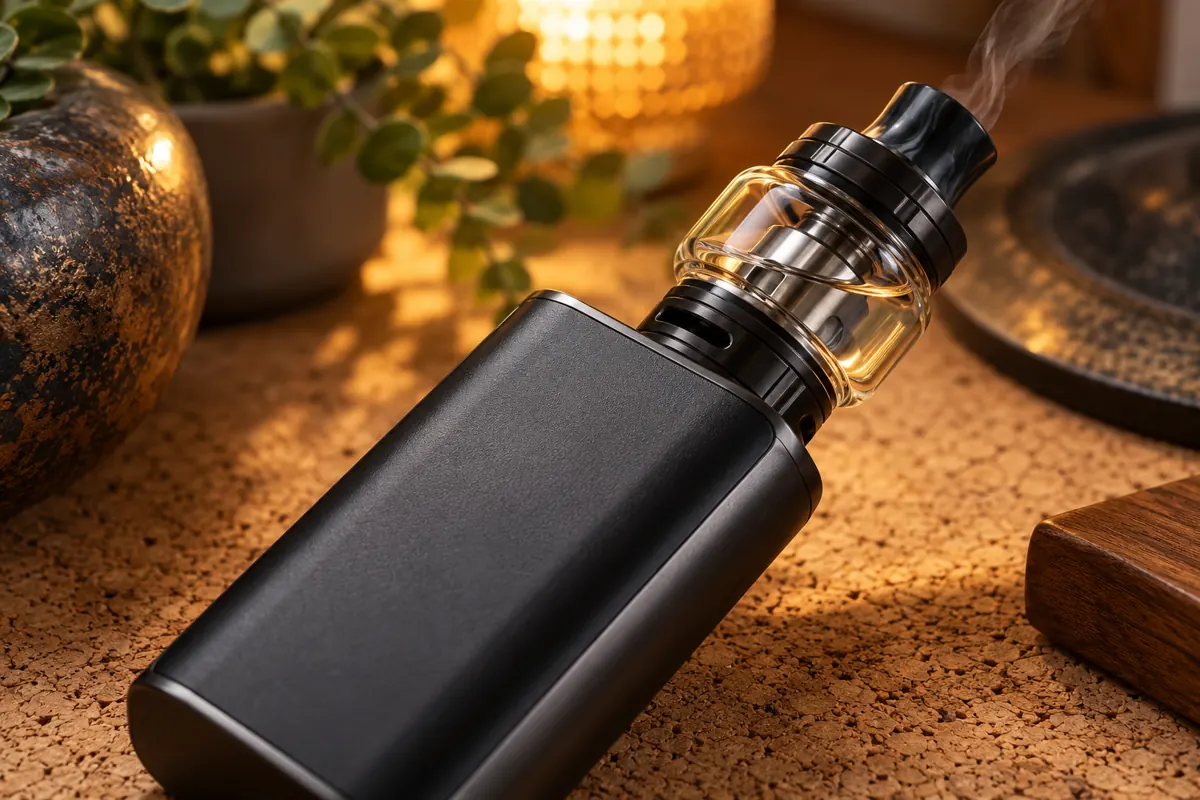
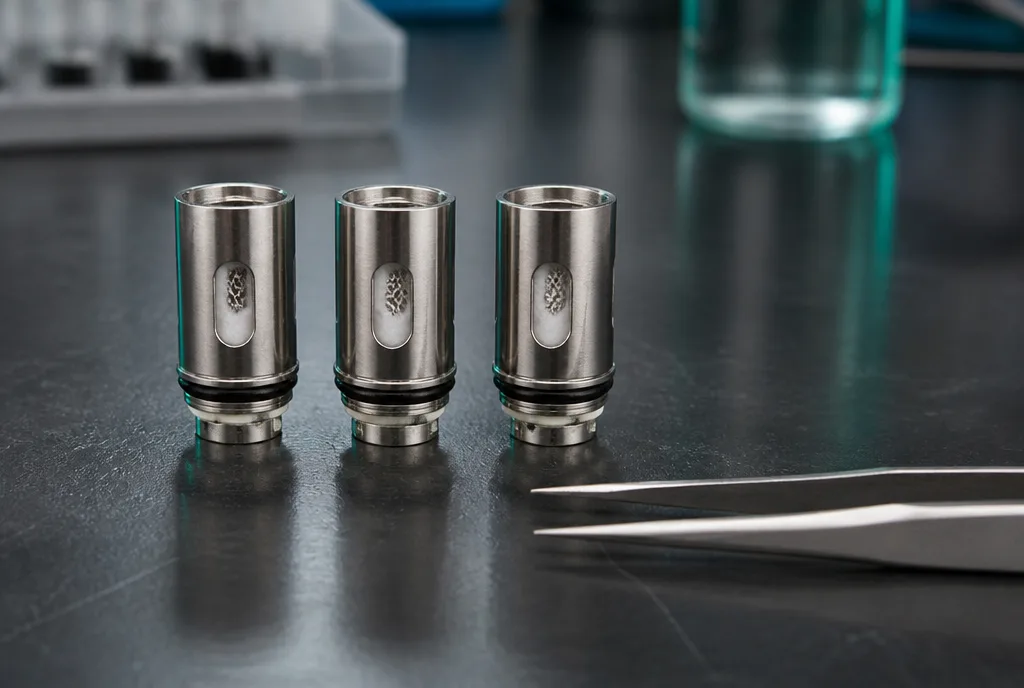
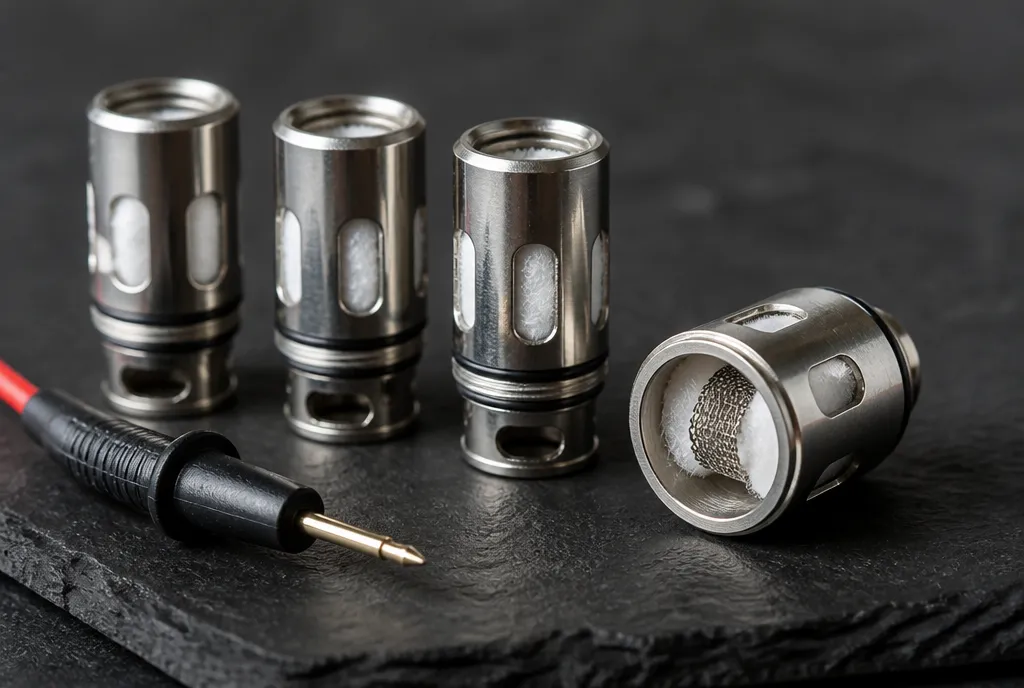
Innokin kit maths, seven batteries and seven chipsets worked out
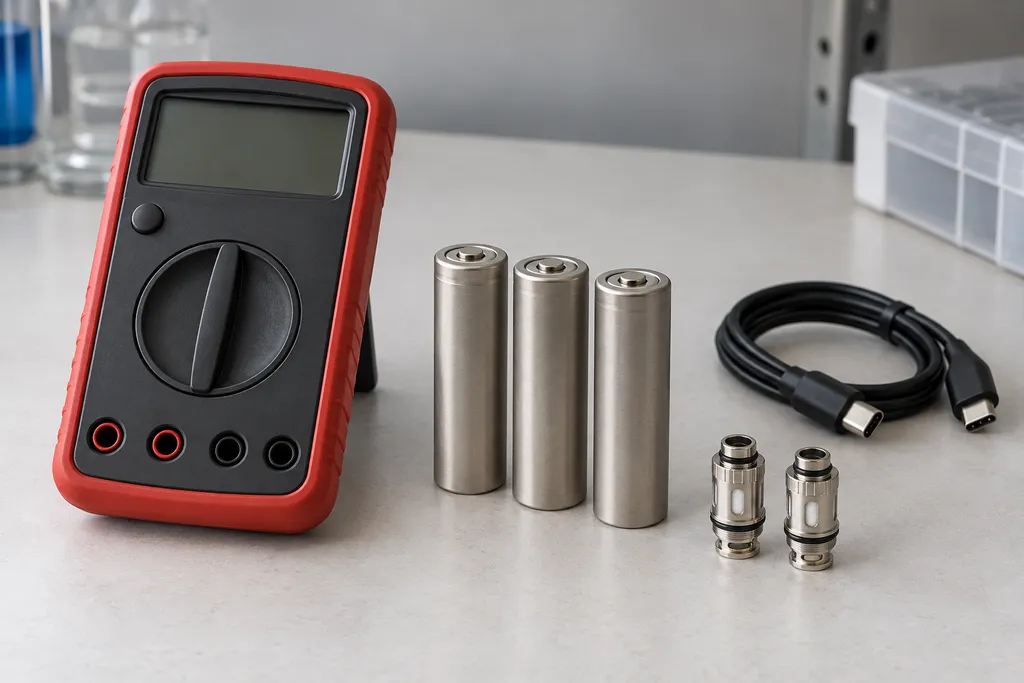
On an Innokin kit listing, two figures catch the eye, the battery capacity in mAh and the maximum output in watts. Neither tells you what the device will actually deliver to the coil fitted to it. A mod rated at 60 W can top out far lower on a 1.6 ohm head, and the largest battery in a catalogue does not necessarily fire for the longest. The lab took the manufacturer’s listings for seven kits and redid the sums.
Which Innokin kit to choose for the coil it drives
The right Innokin kit is chosen from the lowest coil value you plan to use, because that head puts the most strain on the battery and the chipset. For a mouth-to-lung draw between 10 and 20 W, the Klypse Pro, Trine Q and Zyon pods are enough, with just over 6 A at most to supply.
For a restricted direct lung draw on a 0.3 ohm Z-Coil at 40 W, the EZ Tube and the Kroma Z reach exactly the level required, with nothing in reserve. To push a 0.2 ohm coil beyond 40 W, you need the Coolfire Z60 or the Coolfire PZPulse, the only two of the seven to exceed 17 A at the coil.
The rest depends on what you expect from the battery. A short recharge, a long firing time and high power do not always come together, and the sections below put numbers on that, model by model.
The Innokin kit calculation table
Capacities, wattage ranges and coil values come from Innokin’s own listings. Watt-hours are worked out at a nominal 3.7 V, the figure the manufacturer itself uses for the Coolfire Z60. Voltage and current follow Ohm’s law, at the top of the range of the lowest coil value each listing names.
| Kit | Battery | Energy | Lowest coil value | Top wattage | Voltage | Current |
|---|---|---|---|---|---|---|
| Klypse Pro | 1000 mAh | 3.70 Wh | 0.6 ohm pod | 22 W | 3.63 V | 6.1 A |
| Trine Q | 1050 mAh | 3.89 Wh | 0.6 ohm pod | 20 W | 3.46 V | 5.8 A |
| Zyon | 1300 mAh | 4.81 Wh | PZP 0.6 ohm | 24 W | 3.79 V | 6.3 A |
| EZ Tube | 2100 mAh | 7.77 Wh | Z-Coil 0.3 ohm | 40 W | 3.46 V | 11.5 A |
| Kroma Z | 3000 mAh | 11.10 Wh | Z-Coil 0.3 ohm | 40 W | 3.46 V | 11.5 A |
| Coolfire Z60 | 2500 mAh | 9.25 Wh | 0.2 ohm, the mod’s floor | 60 W | 3.46 V | 17.3 A |
| Coolfire PZPulse | 2400 mAh | 8.88 Wh | PZP Max 0.2 ohm | 80 W | 4.00 V | 20.0 A |
Current nearly triples between a cartridge pod and a mod, from 6 A to more than 17 A. At the same wattage a lower value runs no hotter, but it asks more current of the chipset and the battery. The table shows the current at the coil. On the battery side, current is roughly the power divided by the cell voltage, around 16 A for 60 W at 3.7 V, and more as the battery runs down. Wattage ranges alone do not show this, as our bench test of Innokin’s eight Z-Coils points out.
Several listings also quote tanks above 2 ml, 4.5 ml for the Zyon and the Kroma Z, 5.5 ml for the PZPulse, 4 ml for the EZ Tube and 3 ml for one Trine Q pod. In the UK, refillable tanks and pods are capped at 2 ml, and Innokin publishes a 2 ml TPD version of the Kroma Z and the EZ Tube. Nicotine e-liquid is likewise limited to 20 mg/ml in bottles of 10 ml at most.
Innokin kit battery life, from watt-hours to minutes of firing
Milliamp-hours only compare well at the same voltage. Watt-hours, on the other hand, divide by the wattage you set and give a cumulative firing time, in other words the total number of seconds during which the coil is powered.
One charge at the top of the range
At the top of the range of its lowest coil value, a full charge works out at about 10 minutes of cumulative firing for the Klypse Pro, 11.7 for the Trine Q and the EZ Tube, 12 for the Zyon and 16.7 for the Kroma Z. The Coolfire PZPulse, at 80 W on its 0.2 ohm head, drops to 6.7 minutes despite its 2400 mAh.
These are theoretical ceilings. They leave out the chipset’s efficiency and the voltage sag towards the end of a charge, two losses that no device avoids.
Why the biggest battery does not always fire the longest
Capacity means little without the wattage it has to feed. Set to 13 W on the 0.6 ohm DuoPrime head it ships with, the Coolfire Z60 offers 42.7 minutes of firing in theory, against 9.25 minutes at 60 W. The Kroma Z goes from 16.7 minutes on the 0.3 ohm head to 37 minutes on the 0.8 ohm Z-Coil set to 18 W.
On the same Innokin kit, firing time can therefore vary by a factor of more than four depending on the head fitted. Our vape wattage chart by ohm helps place the starting wattage for each value.
Voltage and current, the hidden ceilings in two Innokin listings
Only two listings publish the device’s electrical limits, those of the Coolfire Z60 and the Zyon. They are enough to show that a wattage range cannot be reached with every coil.
Coolfire Z60, 7.5 V and 17.5 A
The Coolfire Z60 delivers 1.0 to 7.5 V, with a maximum current of 17.5 A, for a range of 6 to 60 W and coils from 0.2 to 3.5 ohms. Power equals the square of the voltage divided by the resistance, so 60 W is only reachable below 0.94 ohm.
Above that, voltage sets the ceiling, at 35.2 W on a 1.6 ohm head and 16.1 W on a 3.5 ohm one. At the other end, 60 W on 0.2 ohm calls for 17.3 A, just under the 17.5 A quoted. The mod therefore covers its whole resistance range, but with no headroom at the bottom.
Zyon, 4.2 V at most
The Zyon works between 2.0 and 4.2 V for an output of 6 to 25 W. Its 25 W can only be reached below 0.71 ohm, so with the 0.6 ohm PZP head, while the 1.0 ohm PZP tops out at 17.6 W and the 1.2 ohm at 14.7 W.
Those ceilings stay above the recommended ranges, 9 to 13 W and 10 to 13 W, and do not get in the way of normal use. A screen set to 25 W cannot, however, translate into more than 14.7 W on the 1.2 ohm head.
Maximum output against the supplied coil, each kit’s headroom
Comparing an Innokin kit’s maximum output with the needs of its hungriest coil shows whether any reserve is left. On that point, the seven kits fall into two groups.
The EZ Tube and the Kroma Z, both limited to 40 W, ship with a 0.3 ohm Z-Coil rated at 30 to 40 W. Its upper limit matches the maximum of both devices, which have no headroom on that head. The Kroma Z accepts coils down to 0.2 ohm, but always within its 40 W ceiling.
The cartridge pods follow the same pattern. The Klypse Pro reaches 25 W for a 0.6 ohm pod rated at 22 W at most, and the Trine Q 20 W for a 0.6 ohm pod rated at 17 to 20 W.
The Coolfire PZPulse sizes its chipset on its lowest head, the 0.2 ohm PZP Max rated at 60 to 80 W, for a maximum of 80 W. Its 20 A at the top of that range is the highest current in this comparison, a regime our guide to the sub-ohm tank places within the style of draw that calls for it.
Charging, what the charger’s watts tell you
The listings give the charging voltage and current, 5 V and 0.75 to 2 A. Multiplied together they give a power figure, which sets a minimum charging time once set against the watt-hours.
Dividing the battery’s energy by the input power gives at least 44 minutes for the Klypse Pro and 46 for the Trine Q, both charged at 5 V and 1 A. The EZ Tube, at 1.5 A, needs at least 62 minutes. The Zyon, limited to 750 mA, comes to 77 minutes with a battery of only 1300 mAh.
The Coolfire PZPulse, charged at 2 A, serves as a check. Its 80% of 8.88 Wh is 7.1 Wh, so a minimum of around 43 minutes at 10 W, which fits the hour Innokin quotes to reach 80%. For the Kroma Z and the Coolfire Z60, the listing gives a current of 1.7 A with no voltage, so the sum cannot be done.
Real charging always takes longer, because charging slows towards the end and part of the energy is lost as heat.
The verdict by profile
No kit covers every profile, and the maths separates them use by use. The Coolfire Z60 stands out on one specific point, as the only listing in the group that publishes both its maximum voltage and its maximum current, and its chipset covers its whole range, from 0.2 to 3.5 ohms.
| Profile | Kit the maths points to | What the maths says |
|---|---|---|
| Mouth-to-lung, short recharge | Klypse Pro | 3.70 Wh, at least 44 minutes to charge at 5 V and 1 A |
| Mouth-to-lung, firing time | Zyon | 4.81 Wh, 12 minutes at the top of the 0.6 ohm range |
| Compact restricted direct lung | Kroma Z | 11.10 Wh, 16.7 minutes at 40 W on the 0.3 ohm head |
| All-round mod | Coolfire Z60 | 7.5 V and 17.5 A published, 0.2 to 3.5 ohms |
| High power | Coolfire PZPulse | 80 W and 20 A on the 0.2 ohm PZP Max |
FAQ
These five questions are about the listings themselves and what they leave out.
Why does the Trine Q listing give two wattages for the same pod?
The page first lists ranges, 9 to 11 W for the 1.2 ohm, 13 to 15 W for the 0.8 ohm and 17 to 20 W for the 0.6 ohm. Its specification table keeps a single figure per pod, 11, 15 and 20 W, which is the upper limit. Starting from the bottom of the range remains the cautious reading.
How long does an Innokin coil last?
The Z-Coil listings give no figure. For the Trine Q, Innokin claims up to 9,000 puffs per 3 ml pod, a manufacturer estimate that varies with the liquid and the wattage, and a pod size that UK rules cap at 2 ml. The signs of wear are covered in our piece on how long a vape coil lasts.
What does the IP68 rating on the Coolfire PZPulse mean?
The IP code of the IEC 60529 standard grades how well a casing is protected. The 6 means fully dust-tight, the 8 means protection against prolonged immersion under conditions set by the manufacturer. Such a rating does not turn the kit into something to dunk in water.
Does the Klypse Pro take the 1.2 ohm pod?
Yes. Its listing gives it a range of 11 to 12 W, alongside the 0.6 ohm (20 to 22 W) and the 0.8 ohm (12 to 13 W). The box holds one 0.6 ohm pod and one 0.8 ohm pod, and the 1.2 ohm is bought separately.
Why is the Coolfire Z80 NEX missing from the table?
Its listing specifies a removable 18650 cell that is not included, with no reference capacity, voltage or maximum current. Its energy therefore depends on the cell you choose, and none of the lab’s sums can rest on a published figure.
Innokin kit choice, start from the lowest coil, not the battery
Across seven listings, capacity in mAh ranks the devices poorly. Watt-hours, the wattage the head calls for and the voltage and current limits describe far better what a device can deliver, and three formulas are enough to work them out.
Before choosing an Innokin kit, start from the lowest coil value you will use, check that the chipset covers it with some margin, then compare the minutes of firing at that wattage. It is the method the lab applies to any tank that lands on its bench.
Editorial content for adult readers only. Vaping products can contain nicotine, which is a highly addictive substance. Vaping products are not for sale to anyone under 18 in the UK. This article is not a buying recommendation.